

In historical reenactment, it is essential to use terms precisely to respect the cultural and historical specifics of each group. Terms such as ‘Clan,’ ‘Sippe,’ ‘Kindred,’ ‘Družina,’ and ‘Hird’ are often used (sometimes improperly) as synonyms to refer to family or social groups. However, each word has a distinct origin and context that determines its proper usage. A casual or “creative” use of these terms risks turning a rich cultural heritage into a meaningless caricature.
Clan

In Celtic cultures, particularly in Scotland and Ireland, the clan represents a group of families sharing a common ancestor. The term is borrowed from the Gaelic clann, a noun translatable as ‘children, lineage; bond.’ Clans were fundamental to social organization, with a strong collective identity based on blood ties and territory. This social structure became predominant during the Middle Ages, with the rise of aristocratic families who used the clan to consolidate their power. (MacDonald, 1999)
Sippe

In ancient Germanic societies, the term ‘Sippe’ referred to an extended kinship community, similar to the concept of a clan in Celtic cultures. The Sippe was a network of blood ties that served as the basis for political and social organization. The term originates from the Proto-Germanic sibjō, meaning ‘kinship,’ and represented a tribal form of organization centered around the concept of fēhida, an Old High German noun translatable as ‘feud.’ Vengeance was thus a legal tool for asserting rights and justice. The Sippe played vital social roles such as regulating the use of natural resources and ensuring mutual protection. (Beekes, 2010)
Kindred

This term indicates a group of people connected by blood ties or kinship. ‘Kindred’ derives from Old English, specifically from the noun cynrēd, which consists of cynn (‘family’) and the suffix -rǣden, which defines a status—in this case, ‘family status.’ In the Germanic tradition, kindred identified an extended family community that formed the foundational core of society. Among the Anglo-Saxons, the kindred was not just a group of blood relatives but also a legal and political entity, as evidenced by Anglo-Saxon laws concerning inheritance matters. (Whitelock, 1979)
Družina
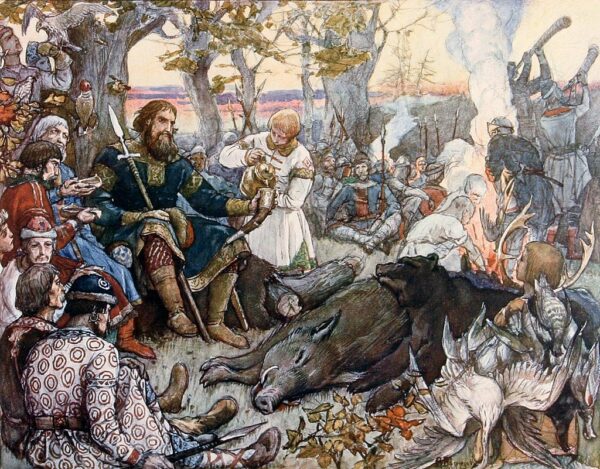
In contemporary Slavic languages, the noun družina has different meanings depending on the context. In Russian, historically, it referred to a military company or a group of companions serving a prince or leader. However, in Southern Slavic languages, such as Slovenian, the noun družina means ‘family,’ just like the Proto-Slavic noun from which it derives. This connection to the family dimension is also evident in the medieval družina, which was the bodyguard of a lord composed of men who considered themselves a brotherhood. A historical reenactment group representing a medieval Slavic company should therefore interpret the družina not as a random structure that includes everyone but as a company of warriors bound by an almost familial relationship, with a clear loyalty to their leader. (Runciman, 2009)
Hird

The term Hird originates in Norse and medieval Scandinavian societies, where it referred to the personal retinue of warriors and servants of a king or chieftain. Derived from Old Norse hirð, meaning ‘court’ or ‘retinue,’ the Hird was not merely a military formation but also a social community bound by loyalty to its lord. The composition of the Hird included both professional warriors and advisors and officials, demonstrating its multifunctional role. The Hird had a highly organized structure, regulated by laws known as Hirdskrá, a collection of rules defining the duties and responsibilities of its members. In a Slavic-Scandinavian historical reenactment, a Hird should represent a well-organized Norse royal court, with clear roles and a communal ethos emphasizing loyalty and service to the leader. (Bagge, 1997)
Correct Use of Družina, Sippe, and Hird in a Slavic-Scandinavian Historical Reenactment Context
Let us imagine a reenactment group representing medieval Norse and Slavic warriors. In this case:
- The Družina would represent a group of Slavic warriors following a Slavic leader, bound by a relationship of loyalty and brotherhood, evoking the image of a “military family” acting as the lord’s bodyguard. It could also include not only the armed retinue but also their families.
- The Sippe, on the other hand, would be more appropriate to represent a Germanic family entity, expressing a blood connection among its members while maintaining independence from the military sphere.
- The Hird, finally, would perfectly fit as the Scandinavian warrior elite following a Norse chieftain, a company regulated by strict codes and distinguished by high professionalism in both military and administrative fields.
The Clan is deliberately omitted from this list, as it has nothing to do with the historical context in question and is in no way related to Scandinavians and Slavs.
Conclusion
Understanding and respecting the origins and meanings of terms such as družina, Sippe, Hird, clan, and kindred is essential for an authentic and respectful historical reenactment. Each word encapsulates centuries of cultural and social evolution, representing organizational structures and values deeply rooted in the societies that created them. Using them carelessly or out of context not only diminishes the reenactment experience but risks turning an important work of historical reconstruction into an anachronistic misunderstanding.
Reenacting is not just about wearing a period costume or wielding a historical weapon—it is an opportunity to bring ancient cultures to life, convey their complexity, and highlight their uniqueness. For instance, using the term družina accurately does not merely describe a “band of warriors” but allows one to recount the deep loyalty and sense of brotherhood that animated medieval Slavic fighters. Similarly, a well-represented Hird speaks of hierarchy, shared rules, and professionalism in Scandinavian society. A Sippe, with its blood ties and concept of internal justice, brings us back to the Germanic vision of the family community as the fundamental core of society.
In a world where attention to detail is often sacrificed on the altar of simplification, choosing to delve into the meaning of these terms and use them with awareness becomes an act of respect for the past and for those who observe us today. More than a detail, it is a message: we are carrying forward a history, not just a representation.
Recognizing the value of each term, placing it in the correct context, and conveying its depth not only enriches the reenactment itself but also engages all participants, whether reenactors, spectators, or history enthusiasts. Respecting these distinctions does not mean complicating the narrative but giving it depth and meaning, transforming a simple performance into a living window into the past.
So, whether you are a Celtic Clan, a Germanic Sippe, an Anglo-Saxon Kindred, a Slavic Družina, or a Scandinavian Hird, the message is clear: call yourselves what you truly are and be proud of it. Honor the traditions you represent, and remember that precision is not pedantry but the first step toward reenactment that is truly living history.
Bibliography
Bagge, Sverre. The Political Thought of the King’s Mirror. Odense: Odense University Press, 1997.
Beekes, Robert S. P. Etymological Dictionary of Greek. Leiden: Brill, 2010.
MacDonald, William. The Clans of Scotland. Edinburgh: Birlinn, 1999.
Runciman, Steven. The Byzantine Theocracy. Cambridge: Cambridge University Press, 2009.
Whitelock, Dorothy. Anglo-Saxon Wills. Oxford: Oxford University Press, 1979.